
 Send Inquiry


 Send Inquiry
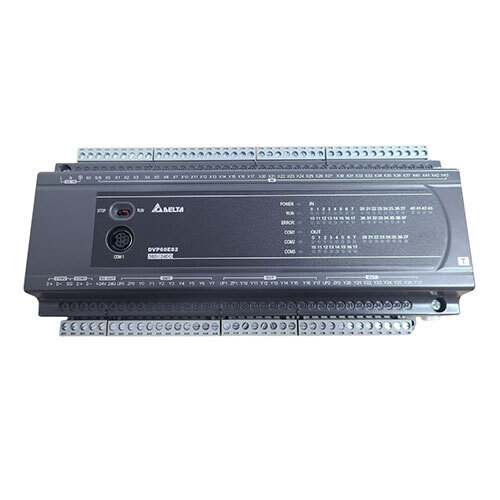
PLC AS Series
PLC AS Series Specification
- Mounting Type
- DIN Rail Mounting
- Automation Grade
- Automatic
- Control Type
- Digital
- Sensor Type
- Compatible with Multiple Sensors
- Phase
- Single/Three Phase
- Application
- Industrial Automation, Machine Control, Process Control
- Processor Type
- High-Speed Microprocessor
- Weight
- Approx. 300-700g depending on model Grams (g)
- Features
- Modular design, high-speed processing, expanded memory
- Speed Range
- Programmable
- IP Rating
- IP20
- Connectivity Type
- Ethernet, RS-232, RS-485
- Frequency
- 50/60 Hz Hertz (HZ)
- Remote Control
- Yes
- Material
- Plastic and Metal
- Power
- 24V Volt (v)
- Temperature
- 0°C to 55°C Celsius (oC)
- Voltage
- 24V DC, 100-240V AC Volt (v)
- Display
- Status LED Indicators
- Status Indication
- LED Displays for Operation and Error
- Number of I/O Points
- Up to 1024
- Programming Language
- Ladder Diagram, Function Block Diagram
- Protection
- Short Circuit and Overvoltage Protection
- Response Time
- 0.2 ms to 0.3 ms/instruction
- Memory
- 128 kB to 256 kB
- Operating Humidity
- 5% to 95% RH, non-condensing
- Cooling Type
- Natural Air Cooling
- Expansion Capability
- Yes, with Additional Modules
About PLC AS Series
Applications: Automated equipment such as electronics manufacturing, labeling, food packaging, and textile machines
Specifications:
- New 32-bit SoC (System on Chip) CPU
- I/O: 1,024
- Program capacity: AS300 series 128k steps, AS200 series 64k steps
- Data registers: 60k words
- Extension modules: max. 32 (analog modules: max.16 / commu-nication modules: max. 4)
- Execution speed: up to 40 k steps / ms
- Basic instruction (LD): 25 ns
- Application instruction (MOV): 0.15 s
- Abundant selection of DIO modules, AIO modules, temperature modules, load cell module and function cards
Modular and Expandable Design
The PLC AS Series boasts a modular architecture that allows users to scale I/O points according to their precise requirements, up to 1024 points. Expansion is possible with additional modules, enabling future-proof customization for diverse automation and machine control applications.
Fast and Reliable Performance
Equipped with a high-speed microprocessor, the PLC AS Series processes instructions in just 0.2 to 0.3 milliseconds. This rapid response, combined with robust protection against short circuits and overvoltage, ensures both speed and reliability for demanding industrial operations.
Versatile Connectivity and Mounting Options
Supporting Ethernet, RS-232, and RS-485 commu-nication, the PLC AS Series easily integrates with various control systems. DIN rail mounting and status LED indicators simplify installation and real-time monitoring. Sensor compatibility and customizable cable lengths further enhance application flexibility.
FAQ's of PLC AS Series:
Q: How can the PLC AS Series be expanded to accommodate more I/O points?
A: The PLC AS Series features a modular design, allowing users to increase the number of I/O points up to 1024 by adding expansion modules. This process is straightforward and can be done as your application grows, without replacing the main controller.Q: What programming languages are supported for configuring the PLC AS Series?
A: You can program the PLC AS Series using Ladder Diagram or Function Block Diagram languages, making it accessible for engineers familiar with traditional or structured programming methodologies.Q: Where is the PLC AS Series commonly used in industrial settings?
A: This PLC is widely deployed in industrial automation, machine control, and process control environments across India. Its robust features make it suitable for manufacturing plants, assembly lines, and various automated systems.Q: When should I use additional protection for the PLC in my system?
A: The PLC AS Series comes with built-in short circuit and overvoltage protection. However, it is advisable to ensure overall system protection, especially in facilities with frequent power fluctuations or harsh conditions, by supplementing with external protective devices if necessary.Q: What are the benefits of using the PLC AS Series for automation?
A: Benefits include high-speed processing for real-time control, expanded memory for complex tasks, modular expansion for evolving needs, and versatile commun-ication ports for easy integration into different industrial networks. These features enhance productivity and operational efficiency.Q: What types of sensors are compatible with the PLC AS Series?
A: The PLC AS Series supports a wide range of sensors, enabling users to connect multiple sensor types according to the application's requirements. This flexibility allows seamless integration into various monitoring and control setups.Q: How do the status LED indicators and display features assist with PLC operation?
A: Status LED indicators provide real-time feedback on operation and error conditions, helping operators quickly identify issues and maintain smooth process control without extensive troubleshooting.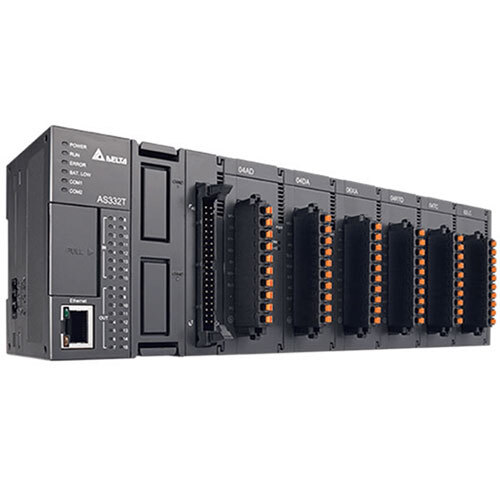
Tell us about your requirement

Price:
Quantity
Select Unit
- 50
- 100
- 200
- 250
- 500
- 1000+
Additional detail
Mobile number
Email

More Products in Delta PLC Category
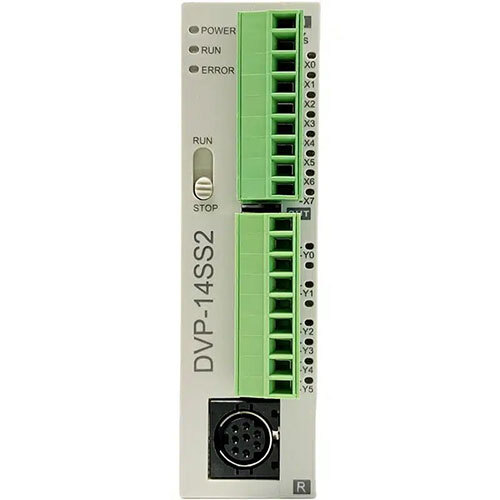
Delta S Series PLC - 24VDC
Automation Grade : Automatic
Phase : Single Phase
Processor Type : Digital Processor
Features : Energy Efficient, Compact Size
Weight : 800 gm
Remote Control : Yes
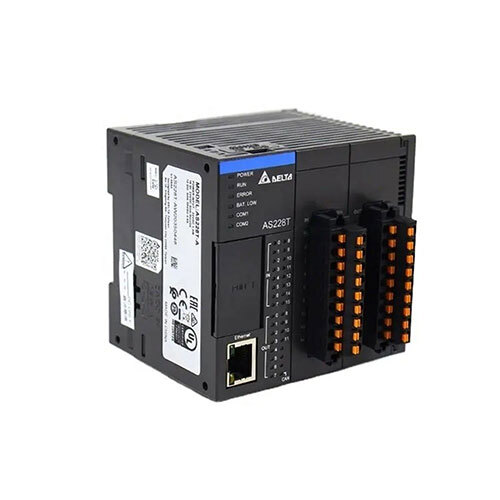
AS Series Motion CPU
Automation Grade : Automatic
Phase : Single Phase
Processor Type : 32bit CPU
Features : Highspeed pulse output, motion control functions, flexible programming.
Weight : Approx. 200g Grams (g)
Remote Control : Yes
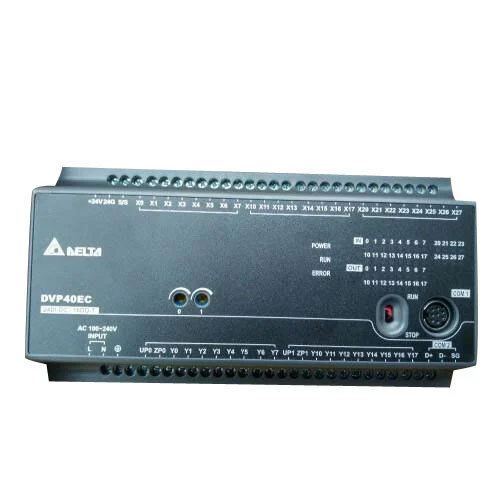
EC3 series
Automation Grade : Automatic
Phase : Single & Three Phase options
Processor Type : Highspeed Microcontroller Based
Features : Compact Design, Overload Protection, Short Circuit Protection, Auto Restart, Energy Saving
Weight : Approx. 1.5 kg Kilograms (kg)
Remote Control : Yes
ES3 Series
Automation Grade : Automatic
Phase : Three Phase
Processor Type : DSP Based
Features : Overload Protection, Short Circuit Protection, High Efficiency
Weight : 3 kg 13 kg (according to Model) Kilograms (kg)
Remote Control : Yes

Contact Details
UNITED CONTROL ENGINEERS INDIA PRIVATE LIMITED
GST : 09AACCU4195M1ZP
GST : 09AACCU4195M1ZP

- Plot No. 98, Toy City, Ecotech-3rd, Greater Noida - 201306, Uttar Pradesh, India
- Phone :08071793171
- Mr Sumit Agrawal (Director)
Mr. Pramendra Chaudhary (Director)
Mobile :+919311150492, +919990632600, +919999706958 -
 marketing@unitedcontrolengg.com
 Send Inquiry
 Send SMS

|
UNITED CONTROL ENGINEERS INDIA PRIVATE LIMITED
All Rights Reserved.(Terms of Use)
Developed and Managed by Infocom Network Private Limited.
Developed and Managed by Infocom Network Private Limited.

